


MW: 1302.4 g/mol | 10 Amino Acids (Decapeptide) | KISS1R Agonist | Form:
Lyophilized | Purity: 99%+ HPLC
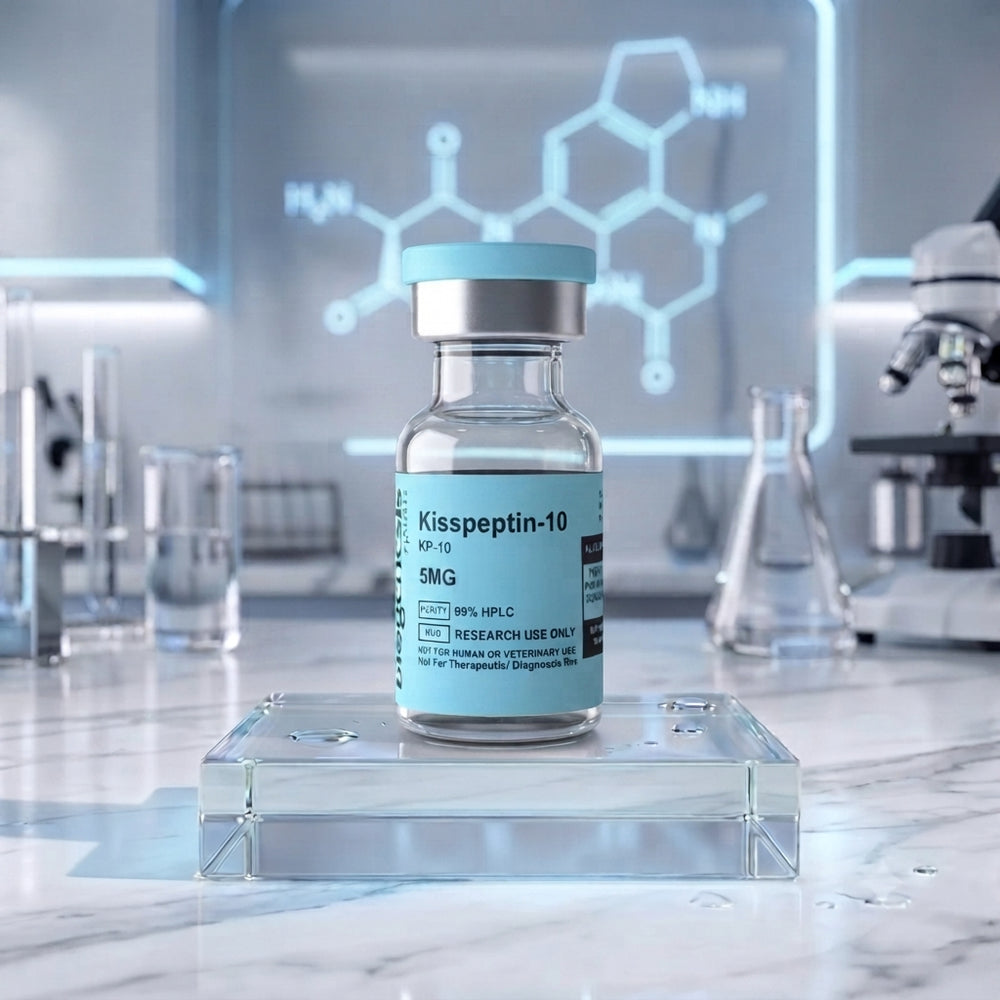
Kisspeptin-10 (KP-10) is a naturally occurring 10-amino-acid decapeptide — the C-terminal fragment (residues 45-54) of kisspeptin-54 — encoded by the KISS1 gene. It is the minimal active fragment that retains full KISS1R (GPR54) receptor binding activity. In preclinical and in-vitro research, KP-10 is studied for hypothalamic GnRH-pulse regulation, LH/FSH secretion pathway research, tumor-metastasis suppression models, limbic brain pathway research, and energy-balance modulation via Kiss1 receptor neurons. Each vial contains 10mg of lyophilized Kisspeptin-10 at 99%+ HPLC-verified purity, with a batch-specific Certificate of Analysis available for download. *
Kisspeptin-10
Kisspeptin-10 (KP-10)
Mechanism of Action• KISS1R / GPR54 Receptor Activation: Binds and activates the kisspeptin receptor (KISS1R / GPR54) on hypothalamic GnRH neurons, triggering calcium mobilization, ERK1/2 and p38 MAPK phosphorylation, and arachidonic acid release — leading to GnRH pulse generation.
• HPG Axis Cascade: KISS1R activation triggers pulsatile GnRH secretion from the hypothalamus, which drives LH and FSH release from the pituitary — the master regulatory cascade of the hypothalamic-pituitary-gonadal (HPG) axis.
• Tumor Migration Suppression: KISS1 gene product activity is studied for suppressing cell migration and invasion in cancer research models, including melanoma, breast, and prostate cell lines.
• Metabolic Sensing & Limbic Pathways: Kiss1 receptor neurons in the hypothalamus respond to nutritional status, linking energy balance to GnRH regulation. KP-10 also interacts with limbic reward pathways in neurological and behavioural research models.
Together these make KP-10 a key tool in HPG-axis, reproductive endocrinology, oncology, and neuroendocrine pathway research.
| Compound | Kisspeptin-10 (KP-10) — C-terminal decapeptide fragment of kisspeptin-54 |
| Sequence | Tyr-Asn-Trp-Asn-Ser-Phe-Gly-Leu-Arg-Phe (YNWNSFGLRF) · C-terminal amide (Phe-NH₂) in active form |
| Amino Acids | 10 (decapeptide) |
| Fragment Residues | 45-54 of kisspeptin-54 |
| Formula | C₆₃H₈₃N₁₇O₁₄ |
| MW | 1302.4 g/mol |
| CAS Number | 388138-21-4 (document ref) · 374675-21-5 also cited (amide form) |
| Synonyms | Metastin (45-54) · KP-10 · KISS1 · Kisspeptin-45-54 |
| Purity | ≥ 99% by HPLC |
| Identity | Confirmed by LC-MS |
| Form | Lyophilized powder |
| Vial Size | 3mL glass vial · 10mg |
| Additives | None |
| Batch COA | Available for download |
- KISS1R / GPR54 receptor binding & HPG-axis pathway research
- GnRH pulse regulation & pituitary LH/FSH secretion research
- Reproductive hormone pathway & neuroendocrine research models
- Tumor migration suppression (KISS1 gene product) cancer research models
- Limbic & reward-pathway neurological research
- Metabolic / nutritional-sensing & energy-balance pathway research
For research teams investigating HPG-axis regulation, neuroendocrine pathways, and reproductive endocrinology.
Storage & HandlingStorage: Store lyophilized powder at -20°C long term; protect from light and moisture. Note: Kisspeptin-10 has a high proportion of hydrophobic amino acids — if reconstituted solution appears turbid, trace acetic acid (0.6%) may be required.
Handling: Research use only; handle by licensed, qualified professionals with PPE.
FEATURED INGREDIENTS
All Ingredients
KISS1 Gene Product — GnRH Master Trigger
The 10-aa C-terminal fragment of kisspeptin-54, studied as the minimal active unit that activates KISS1R (GPR54) receptors — the primary upstream signal that triggers GnRH release from the hypothalamus.
HPG-Axis Pathway Research
Studied for driving the full HPG-axis cascade: KISS1R activation → GnRH pulse → LH/FSH secretion from the pituitary — the master reproductive hormone signalling chain.
Multi-System Research Tool
Beyond reproductive endocrinology — also studied in tumor migration suppression, limbic brain pathway, and metabolic/nutritional-sensing research models.
PRODUCT BENEFITS
-
KISS1 Gene Product — Master GnRH Trigger C-terminal decapeptide (residues 45-54) of kisspeptin-54 — the minimal active fragment that retains full KISS1R binding activity, serving as the primary upstream trigger of hypothalamic GnRH release.
-
HPG-Axis & GnRH Pathway Research Studied for activating KISS1R neurons in the hypothalamus to trigger pulsatile GnRH release, cascading into LH and FSH secretion from the pituitary in reproductive hormone pathway research.
-
Tumor Migration Research Examined as a KISS1 gene product for suppressing metastatic cell migration in cancer research models — originally identified as a metastasis suppressor in melanoma and breast cancer cell lines.
-
Limbic & Reward Pathway Research Studied for activating limbic brain regions linked to motivation, reward, and emotional regulation in neurological and behavioural research models.
-
Metabolic Pathway Research Researched for how Kiss1 receptor neurons respond to nutritional status to regulate GnRH release and energy balance — studied in metabolic and neuroendocrine research models.
-
99%+ HPLC-Verified Purity Independently verified by third-party labs via HPLC and LC-MS; batch-specific COA and SDS available pre-purchase.
CUSTOMERS ALSO PURCHASED

GLP1-T · 15mg Tirzepatide · Dual Receptor Agonist (GLP-1 + GIP) · Metabolic Research

GLP1-S · 5mg Semaglutide · GLP-1 Receptor Agonist · Metabolic Research

MOTS-c 10mg Mitochondria-Derived Peptide

Cagrilintide · 10mg Long-Acting Amylin Analogue · Metabolic & Satiety Research
Loved by thousands


Bundle and save 20%

5-Amino-1MQ · 5mg NNMT Inhibitor · Small Molecule (Quinolinium) · Metabolic & NAD+ Research
- Daily Vitamin
- Probiotics
Kisspeptin-10 is the minimal active fragment of kisspeptin-54 — studied as the master upstream trigger that starts the reproductive hormone cascade. It activates KISS1R receptors on hypothalamic GnRH neurons → triggering GnRH pulses → driving LH and FSH release from the pituitary. Beyond reproductive research, it is also studied in tumor migration suppression, limbic reward pathway, and metabolic nutritional-sensing research models.*

WHAT TO EXPECT

Independently verified by third-party labs

Batch number printed on every vial

Orders before 2 PM EST ship same business day

Plain FedEx/UPS, return label: Shipping Manager

Real human responses within hours
Independently verified by third-party labs
Batch number printed on every vial
Orders before 2 PM EST ship same business day
Plain FedEx/UPS, return label: Shipping Manager
Real human responses within hours
KISS1R / GPR54 Activation — GnRH Cascade
Binds and activates the kisspeptin receptor (KISS1R / GPR54) on hypothalamic GnRH neurons, triggering calcium mobilisation, MAPK phosphorylation, and GnRH pulse generation — the first step of the full HPG-axis cascade (GnRH → LH/FSH → reproductive hormones).
Tumor Migration Suppression Research
As a KISS1 gene product, studied for suppressing metastatic cell migration and invasion in cancer research models — originally identified as a metastasis suppressor in melanoma and breast cancer cell line studies.
Limbic, Reward & Metabolic Pathway Research
Studied for activating limbic brain regions linked to motivation and reward in neurological research models, and for how Kiss1 receptor neurons respond to nutritional status to modulate GnRH release and energy balance in metabolic pathway research.

ALL DETAILS
- KISS1R / GPR54 Activation — GnRH Cascade — Binds and activates the kisspeptin receptor (KISS1R / GPR54) on hypothalamic GnRH neurons, triggering calcium mobilisation, MAPK phosphorylation, and GnRH pulse generation — the first step of the full HPG-axis cascade (GnRH → LH/FSH → reproductive hormones).
- Tumor Migration Suppression Research — As a KISS1 gene product, studied for suppressing metastatic cell migration and invasion in cancer research models — originally identified as a metastasis suppressor in melanoma and breast cancer cell line studies.
- Limbic, Reward & Metabolic Pathway Research — Studied for activating limbic brain regions linked to motivation and reward in neurological research models, and for how Kiss1 receptor neurons respond to nutritional status to modulate GnRH release and energy balance in metabolic pathway research.
The "Kisspeptin-10" Peptide |
No fillers | No artificial additives | No excipients | 99%+ HPLC verified · batch COA | No repackaged imports | No human-use claims |
|---|---|---|---|---|---|---|
|
Kisspeptin-10 Peptide
|
||||||
Other Peptide |
The "Kisspeptin-10" Peptide
| Compare to: | Kisspeptin-10 Peptide |
Other Peptide |
|---|---|---|
| No fillers | ||
| No artificial additives | ||
| No excipients | ||
| 99%+ HPLC verified · batch COA | ||
| No repackaged imports | ||
| No human-use claims |
FAQs
GHK-Cu (Glycyl-L-Histidyl-L-Lysine Copper Complex) is a naturally occurring copper-binding tripeptide studied extensively in preclinical and in vitro research models. It is primarily researched for its role in tissue repair, collagen synthesis, wound healing, gene expression modulation, hair follicle biology, and antioxidant defense pathways.
Lyophilized means the compound has been freeze-dried — water is removed under vacuum to produce a stable powder. This process significantly extends shelf life and preserves compound integrity during storage and shipping. Lyophilized peptides are the research-grade standard because they maintain purity far longer than liquid formulations.
Each batch of GHK-Cu is independently verified at ≥99% purity using HPLC (High-Performance Liquid Chromatography). Identity is further confirmed by LC-MS (Liquid Chromatography-Mass Spectrometry). A batch-specific Certificate of Analysis (COA) is available for download before purchase.
Store lyophilized GHK-Cu at −20°C upon receipt. Keep protected from light, heat, and moisture. Do not open the vial until needed for your research protocol. Under proper storage conditions, lyophilized GHK-Cu maintains compound integrity for up to 24 months.
No. Peptides Verse does not provide reconstitution, dosing, or administration guidance of any kind. All reconstitution protocols are the sole responsibility of the qualified researcher or institution receiving this compound. This product is strictly for in vitro and laboratory research use only.
Yes. A batch-specific COA is available for every vial of GHK-Cu sold by Peptides Verse. The COA includes HPLC purity data, LC-MS identity confirmation, lot number, and testing lab details. It can be downloaded directly from the product page before or after purchase.
GHK refers to the free tripeptide (Glycyl-L-Histidyl-L-Lysine) without copper. GHK-Cu is the copper-chelated form — where a Cu² ion is bound to the tripeptide. The copper-chelated form is the biologically active version studied in most published research on wound healing, collagen synthesis, and gene expression modulation.
No. GHK-Cu from Peptides Verse is strictly for in vitro research and laboratory experimentation only. It is not intended for human or animal use of any kind. By purchasing, the buyer confirms they are a qualified researcher or institution and accepts full responsibility for safe handling and use.
All orders are shipped via FedEx with temperature-appropriate packaging to protect compound integrity during transit. Packaging is discreet — plain FedEx or UPS with no product branding on the exterior. Orders placed before 2 PM EST ship same business day.
Due to the nature of research chemicals, all sales are final once a vial has been opened or the seal broken. If you receive a damaged or incorrect item, contact support@peptidesverse.com within 48 hours of delivery with your order number and photos.