
Description
Overview
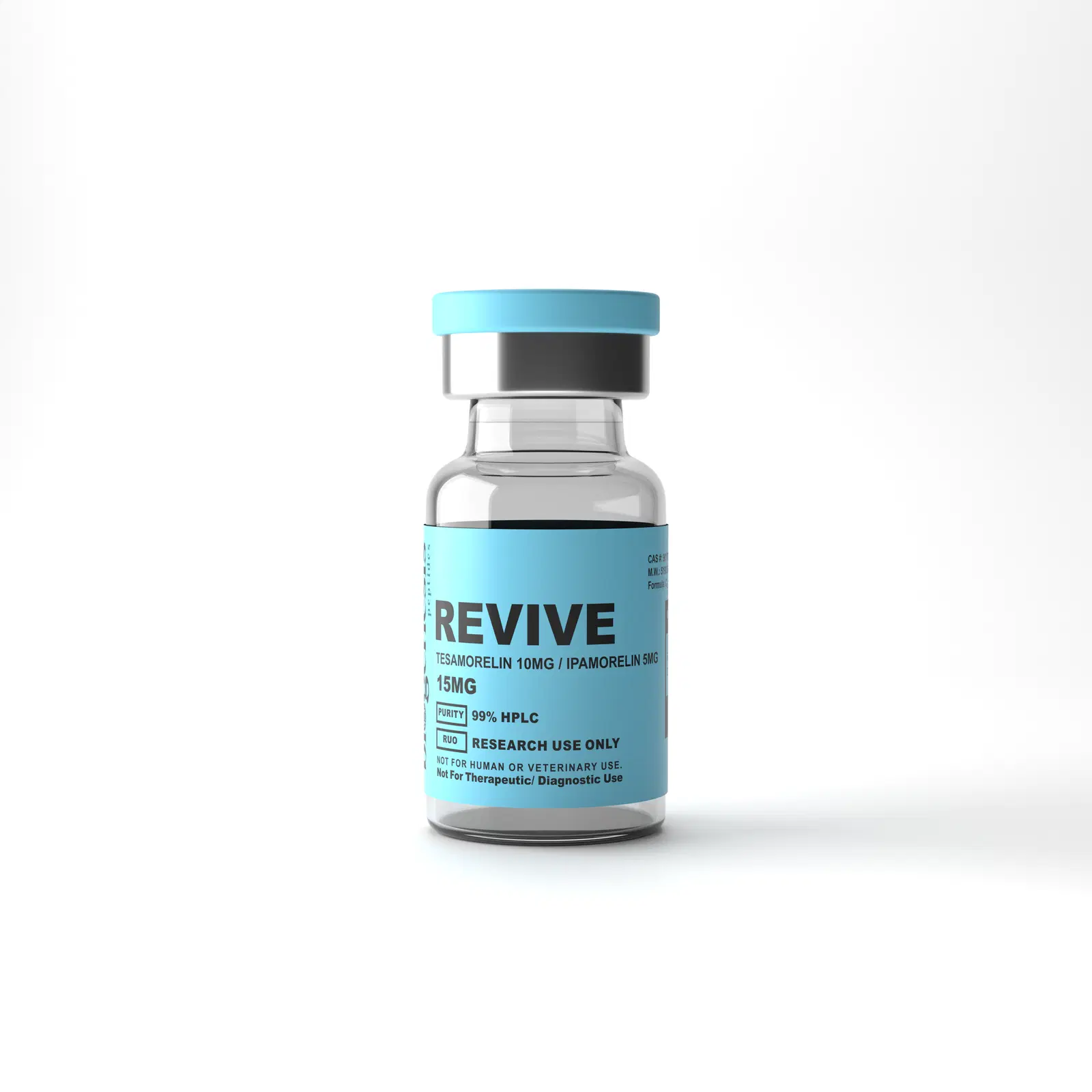
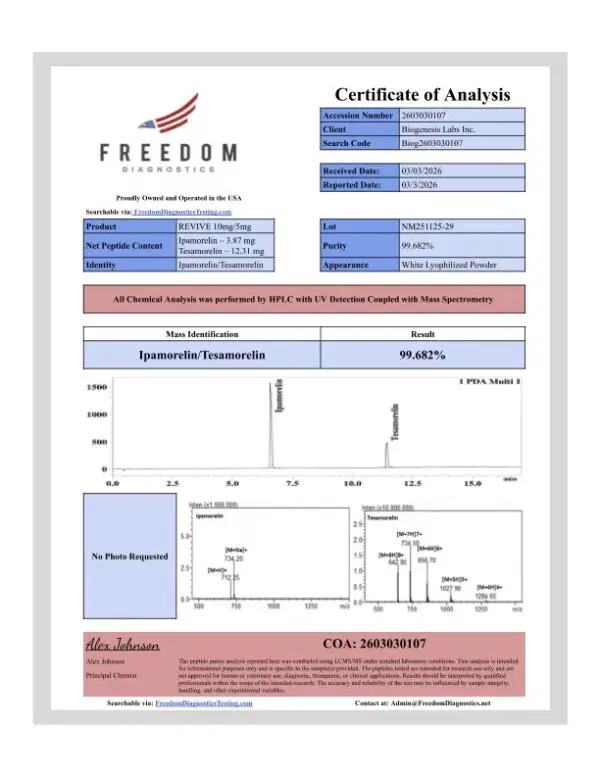
Ipamorelin and Tesamorelin are research peptides that influence the body’s natural growth hormone (GH) regulatory pathways through complementary mechanisms.
Ipamorelin is a highly selective growth hormone secretagogue (GHS) that binds specifically to the ghrelin/growth hormone secretagogue receptor (GHS-R1a). It mimics the body’s natural ghrelin signaling to stimulate growth hormone release while maintaining the normal pulsatile pattern of GH secretion. Unlike many GH secretagogues, Ipamorelin does not significantly affect levels of cortisol, prolactin, ACTH, thyroid-stimulating hormone (TSH), follicle-stimulating hormone (FSH), or luteinizing hormone (LH).
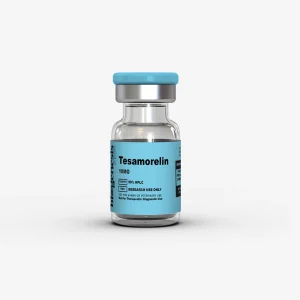
Tesamorelin is a synthetic analogue of growth hormone-releasing hormone (GHRH) composed of 44 amino acids. It stimulates the pituitary gland to release growth hormone through the natural hypothalamic-pituitary axis. Tesamorelin is FDA-approved for the treatment of HIV-associated lipodystrophy and has been widely studied for its effects on visceral fat reduction, metabolic health, and cognitive function.
When studied together, Ipamorelin and Tesamorelin provide a dual-pathway approach to stimulating endogenous growth hormone release—Ipamorelin acting through ghrelin receptors and Tesamorelin acting through GHRH receptors. This complementary signaling may support research exploring growth hormone regulation, metabolic function, tissue repair, and neurological health.
Research
Growth Hormone Regulation
Both peptides stimulate growth hormone through different mechanisms within the endocrine system.
Ipamorelin activates ghrelin receptors (GHS-R1a), triggering a natural increase in GH secretion without overstimulating other hormonal pathways. Tesamorelin stimulates GHRH receptors in the pituitary gland, promoting the body’s physiological release of GH.
Research suggests this dual signaling may:
-
Enhance natural growth hormone secretion
-
Preserve natural GH pulse frequency
-
Avoid endocrine overstimulation seen with direct GH administration
Body Composition and Metabolic Health
Tesamorelin has been extensively studied for reducing visceral adipose tissue, particularly in patients with HIV-associated lipodystrophy. Clinical studies have demonstrated reductions in abdominal fat of nearly 20%.
Ipamorelin may complement these metabolic effects through:
-
Improved fat metabolism
-
Increased protein synthesis
-
Support for lean muscle preservation
Together, these peptides are frequently studied in metabolic research related to body composition and hormonal balance.
Muscle Growth and Tissue Repair
Growth hormone plays an essential role in muscle development, tissue regeneration, and recovery.
Ipamorelin has been shown in research models to:
-
Increase protein synthesis
-
Promote muscle hypertrophy
-
Reduce muscle breakdown
-
Support recovery following injury or surgery
Tesamorelin’s stimulation of GH may further contribute to:
-
Enhanced tissue regeneration
-
Improved metabolic signaling
-
Maintenance of lean muscle mass
These mechanisms have drawn interest in sports medicine and regenerative research.
Bone Health
Long-term glucocorticoid therapy is associated with bone density loss and osteoporosis.
Research suggests Ipamorelin may help:
-
Stimulate osteoblast activity
-
Preserve bone mineral density
-
Prevent steroid-induced bone loss
Growth hormone axis stimulation through Tesamorelin may also support skeletal integrity by enhancing bone remodeling processes.
Neurological and Cognitive Research
Tesamorelin has been investigated for potential neurological benefits, including effects on cognitive function and brain metabolism.
A randomized clinical study found that Tesamorelin may:
-
Increase GABA levels in the brain
-
Reduce myo-inositol associated with neurodegeneration
-
Improve cognitive performance in mild cognitive impairment (MCI)
Additionally, GH-axis stimulation has been explored for supporting peripheral nerve regeneration following injury.
Insulin and Glucose Regulation
Research suggests Ipamorelin may stimulate insulin secretion by activating calcium channels in pancreatic islet cells. This mechanism may support investigations into:
-
Insulin sensitivity
-
Glucose metabolism
-
Metabolic regulation
Structure
Ipamorelin
-
Molecular Formula: C₃₈H₄₉N₉O₅
-
Molecular Weight: 711.868 g/mol
-
Amino Acid Sequence: Aib-His-D-2Nal-D-Phe-Lys
-
CAS Number: 170851-70-4
-
PubChem ID: 9831659
Tesamorelin
-
Molecular Formula: C₂₂₃H₃₇₀N₇₂O₆₉S
-
Molecular Weight: 5195.908 g/mol
-
CAS Number: 901758-09-6
Citations
Raun, K. et al. Ipamorelin, the first selective growth hormone secretagogue. Eur. J. Endocrinol. (1998).
Andersen, N. B. et al. Ipamorelin counteracts glucocorticoid-induced bone loss. Growth Horm. IGF Res. (2001).
Svensson, J. et al. Ipamorelin increases bone mineral content in female rats. J. Endocrinol. (2000).
Adeghate, E. & Ponery, A. S. Ipamorelin stimulates insulin release in diabetic rats. Neuro Endocrinol. Lett. (2004).
Falutz, J. et al. Metabolic effects of a growth hormone-releasing factor in patients with HIV. N. Engl. J. Med. (2007).
Stanley, T. L. et al. Reduction in visceral adiposity with tesamorelin treatment. Clin. Infect. Dis. (2012).
Friedman, S. D. et al. Growth hormone-releasing hormone effects on brain GABA levels. JAMA Neurol. (2013).
Tuffaha, S. H. et al. Therapeutic augmentation of the GH axis following nerve injury. Expert Opin. Ther. Targets (2016).

Reviews
There are no reviews yet.