
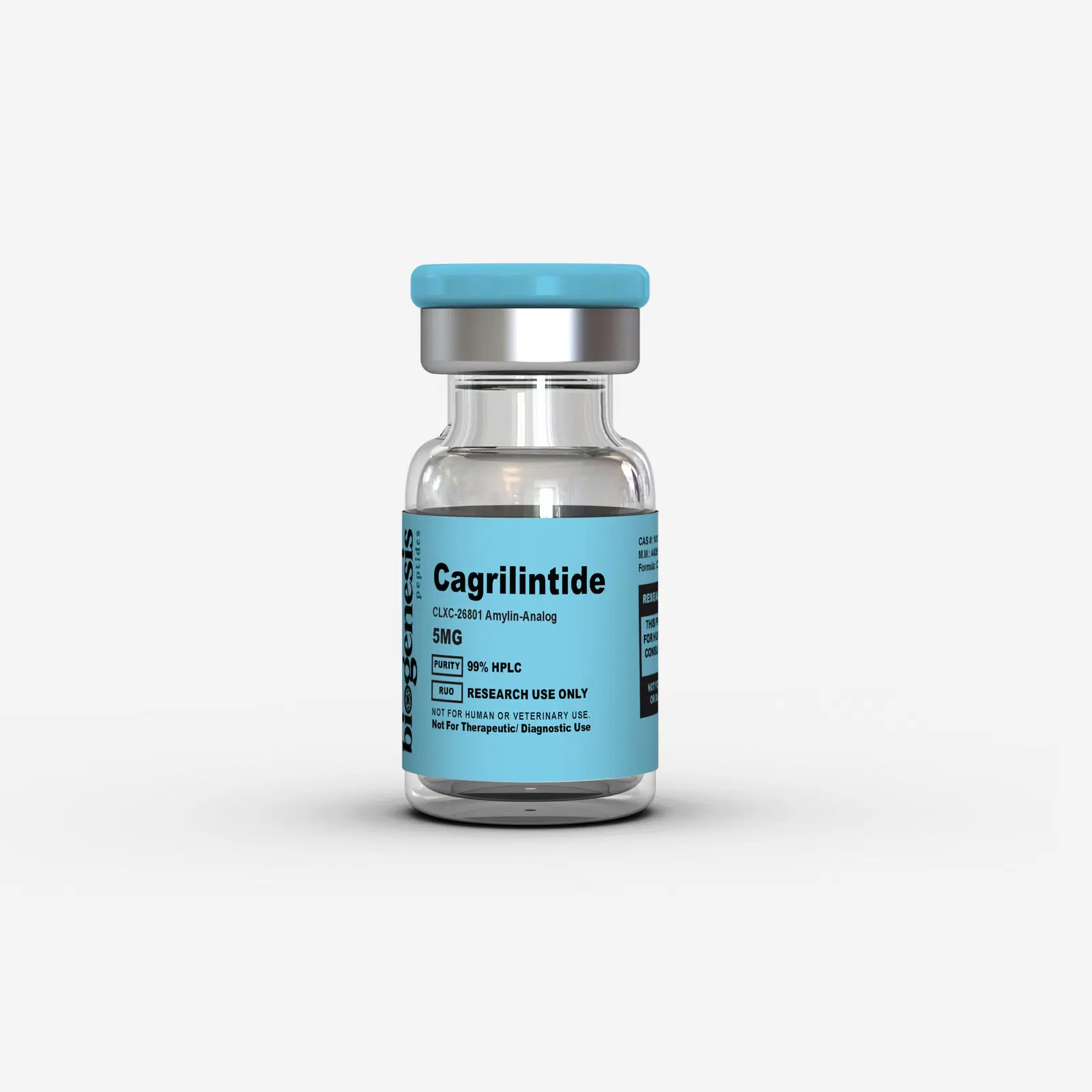
Description
OVERVIEW
Cagrilintide is a long-acting analogue of amylin, a peptide hormone that is naturally secreted alongside insulin. It has shown promise in obesity and type 2 diabetes treatment, with ongoing research exploring its potential applications in liver disease, alcohol-related liver conditions, and cardiovascular health.
While there is speculation about its role in Alzheimer’s disease, no published studies have yet confirmed its effects in this area. Many trials have examined the combination of Cagrilintide and Semaglutide, suggesting that their combined use leads to enhanced and more sustainable weight loss results compared to either peptide alone.
Although early research highlights its potential therapeutic benefits, human clinical trials remain limited, necessitating further investigation to confirm its safety and efficacy.
RESEARCH
Cagrilintide and Amylin
Cagrilintide is a synthetic version of amylin, a hormone co-released with insulin from the pancreas. Amylin plays a crucial role in:
- Regulating blood sugar levels
- Slowing gastric emptying
- Signaling satiety (fullness) to the brain
Unlike natural amylin, Cagrilintide is engineered to resist enzymatic breakdown, resulting in a longer half-life and extended duration of action.
Cagrilintide for Weight Management
Cagrilintide has been evaluated in clinical trials for its potential to support weight loss. In a notable study, individuals receiving Cagrilintide experienced a 6-11% reduction in body weight within just six weeks.
When Cagrilintide is combined with Semaglutide, research suggests their weight loss benefits are synergistic rather than merely additive, leading to reductions in body weight of up to 17.1% within 20 weeks.
Cagrilintide and Diabetes Management
Cagrilintide supports diabetes treatment through several mechanisms:
- Enhancing insulin sensitivity
- Reducing hemoglobin A1C (HbA1c) levels
- Suppressing glucagon secretion
One clinical study demonstrated a 2.2% decrease in HbA1c levels over a short treatment period, with the extended half-life of Cagrilintide allowing for more stable glucose regulation over time.
Cagrilintide and Alzheimer’s Disease
Research has linked amylin to amyloid-beta plaque accumulation, a hallmark of Alzheimer’s disease. High levels of natural amylin can form toxic fibrils that may contribute to cognitive decline.
Some studies suggest that synthetic amylin analogues could aid in clearing amyloid plaques from the brain, but no direct research on Cagrilintide’s role in Alzheimer’s disease has been conducted yet.
STRUCTURE
- Molecular Formula: C₁₉₄H₃₁₂N₅₄O₅₉S₂
- Molecular Weight: 4409.01 g/mol
- CAS Registry Number: 1415456-99-3
- Amino Acid Sequence: XKCNTATCATQRLAEFLRHSSNNFGPILPPTNVGSNTP
- PubChem Identifier: 171397054
CITATIONS
- Pittner, R. A. et al. Molecular physiology of amylin. Journal of Cellular Biochemistry (1994).
- Shen, Y. et al. Structures of human insulin-degrading enzyme reveal a new substrate recognition mechanism.Nature (2006).
- Lutz, T. A. Creating the amylin story. Appetite (2022).
- Kruse, T. et al. Development of Cagrilintide, a Long-Acting Amylin Analogue. Journal of Medicinal Chemistry (2021).
- Hay, D. L., & Pioszak, A. A. Receptor Activity-Modifying Proteins (RAMPs): New Insights and Roles. Annual Review of Pharmacology and Toxicology (2016).
- Dehestani, B. et al. Amylin as a Future Obesity Treatment. Journal of Obesity & Metabolic Syndrome (2021).
- Lau, D. C. W. et al. Once-weekly Cagrilintide for weight management: a multicenter, randomized, placebo-controlled trial. Lancet (2021).
- Enebo, L. B. et al. Safety, tolerability, and pharmacokinetics of Cagrilintide with Semaglutide. Lancet (2021).
- Frias, J. P. et al. Efficacy of co-administered Cagrilintide and Semaglutide in type 2 diabetes. The Lancet (2023).
- Bailey, C. J. et al. Peptide-based therapies for obesity and type 2 diabetes. Peptides (2024).
- Warren, R. E. et al. Hypoglycemia and cognitive function. Diabetes Obesity and Metabolism (2005).
- Zhang, S. et al. Cognitive dysfunction in diabetes: abnormal glucose metabolism in the brain. Frontiers in Endocrinology (2023).
- Yang, Y. et al. Expert Consensus on Cognitive Dysfunction in Diabetes. Current Medical Science (2022).
- Zhu, H. et al. Association of Plasma Amylin Concentration With Alzheimer Disease. JAMA Network Open (2019).
- Qiu, W. et al. Association between amylin and amyloid-β peptides in plasma. PLoS One (2014).

Reviews
There are no reviews yet.