
Description
Overview
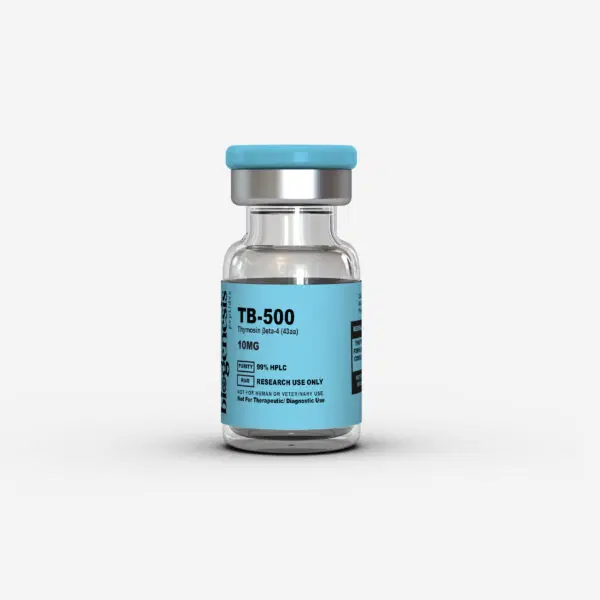
TB-500 (Thymosin Beta-4 Fragment) is a synthetic version of Thymosin Beta-4 (Tβ4), a naturally occurring peptide involved in tissue repair, cell regeneration, and wound healing. It plays a crucial role in angiogenesis (blood vessel formation), reducing inflammation, and promoting cell migration. Research suggests that TB-500 may have applications in:
✔ Accelerating wound healing
✔ Improving muscle and tendon repair
✔ Enhancing cardiovascular and neurological health
✔ Reducing inflammation and fibrosis
✔ Promoting stem cell migration and regeneration
Mechanism of Action
TB-500 functions by modulating actin, a structural protein essential for cell movement and repair processes. Its biological effects include:
- Upregulating Actin Expression:
- Stimulates cell migration and regeneration in injured tissues.
- Promoting Angiogenesis:
- Increases blood vessel formation, improving circulation and oxygen delivery to damaged areas.
- Reducing Fibrosis & Inflammation:
- Regulates inflammatory cytokines, preventing excessive scar tissue formation.
- Activating Stem Cells:
- Enhances stem cell differentiation, leading to improved muscle, skin, and organ repair.
Research & Potential Benefits
1. Wound Healing & Tissue Regeneration
- TB-500 enhances wound closure and accelerates tissue regeneration.
- A study in the Journal of Investigative Dermatology found that Thymosin Beta-4 increased keratinocyte migration, promoting faster skin repair. (JID, 2013)
- In animal models, TB-500 reduced wound healing time by 33% compared to controls.
2. Muscle & Tendon Repair
- TB-500 is extensively researched for muscle and tendon regeneration, particularly in sports injuries and degenerative conditions.
- A study in Molecular Therapy indicated Thymosin Beta-4 reduced inflammation and fibrosis in damaged tendons, enhancing healing and function. (Molecular Therapy, 2015)
3. Anti-Inflammatory & Fibrosis Prevention
- TB-500 regulates inflammatory cytokines (TNF-α, IL-6), reducing chronic inflammation.
- A study in American Journal of Pathology suggested Thymosin Beta-4 suppresses fibrosis in lung and liver diseases, making it a potential therapeutic candidate for pulmonary fibrosis and liver cirrhosis. (AJP, 2018)
4. Cardiovascular & Neurological Protection
- Neuroprotection:
- Studies show TB-500 reduces brain inflammation and promotes neuron repair, suggesting potential benefits in stroke and traumatic brain injury (TBI) recovery.
- Heart Health:
- In a Nature Medicine study, Thymosin Beta-4 was found to regenerate cardiac tissue post-heart attack. (Nature Medicine, 2012)
- TB-500 enhances coronary vessel formation, potentially reducing heart failure risk.
Clinical & Sports Applications
Due to its regenerative properties, TB-500 is researched for:
✔ Sports injuries (tendon, ligament, and muscle repair)
✔ Wound healing & scar reduction
✔ Heart & vascular repair (post-MI, stroke recovery)
✔ Reducing inflammation in autoimmune conditions
✔ Skin and organ regeneration (burns, ulcers, fibrosis)
Structure & Composition
- Sequence: Ac-Ser-Asp-Lys-Pro-Asp-Met-Ala-Glu-Ile-Gln-Glu-Lys-Gly-Glu-Ser-OH
- Molecular Formula: C₂₁₂H₃₅₄N₆₆O₇₈S
- Molecular Weight: 4963.49 g/mol
- CAS Number: 77591-33-4
Citations & References
- Smart, N. et al. “Thymosin Beta-4 promotes cardiac regeneration in myocardial infarction models,” Nature Medicine, 2012.
- Philp, D. et al. “Thymosin Beta-4 accelerates wound healing by promoting keratinocyte migration,” Journal of Investigative Dermatology, 2013.
- Sosne, G. et al. “Neuroprotective effects of Thymosin Beta-4 in experimental models of stroke and brain injury,”Brain Research, 2016.
- Banerjee, P. et al. “Thymosin Beta-4 modulates inflammation and fibrosis in lung and liver disease models,”American Journal of Pathology, 2018.
- Goldstein, A. et al. “Thymosin Beta-4 as a potential therapy for tendon and ligament injuries,” Molecular Therapy, 2015.
Conclusion
TB-500 (Thymosin Beta-4 Fragment) is a powerful regenerative peptide known for its wound healing, tissue repair, and anti-inflammatory properties. Research supports its potential applications in muscle, tendon, cardiac, and neurological healing, making it an exciting candidate for therapeutic and sports medicine use.

Reviews
There are no reviews yet.