
Description
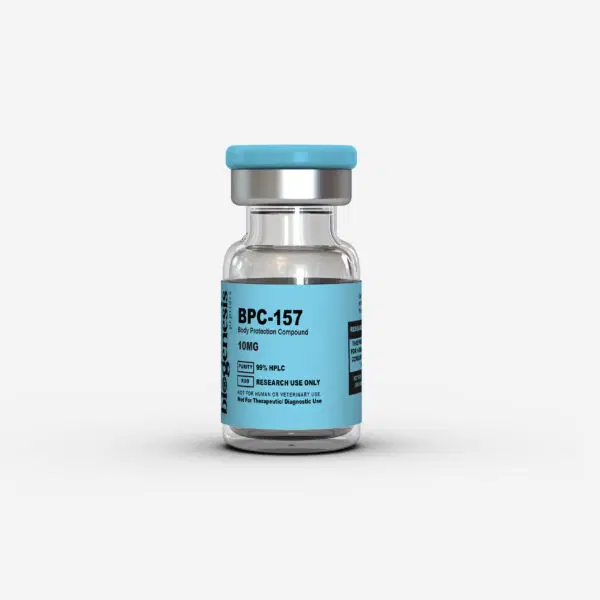
BPC-157, short for Body Protection Compound 157, is a synthetic peptide consisting of 15 amino acids. It originates from a protective protein found in human gastric juice and has been extensively researched for its healing and regenerative properties.
Key Benefits of BPC-157:
- Tissue Regeneration: Supports healing in muscles, tendons, ligaments, and the gastrointestinal (GI) tract.
- Anti-Inflammatory Effects: Reduces inflammation in multiple tissues.
- Organ Protection: Demonstrates protective effects on the stomach lining, liver, and nervous system.
- Wound Healing Acceleration: Promotes angiogenesis (new blood vessel formation) and boosts collagen production.
- Neurological Support: Animal studies suggest potential nerve regeneration and brain healing.
Due to these properties, BPC-157 is being explored for its potential in treating injuries, chronic conditions, and inflammatory diseases.
RESEARCH
BPC-157 and Wound Healing
BPC-157 plays a natural role in the gastrointestinal tract, maintaining the mucosal barrier to protect tissues from gastric acid, bile, and harmful substances. Research suggests that it enhances:
- Fibroblast activity, speeding up wound repair.
- Extracellular matrix production, increasing collagen, fibrin, and elastin synthesis.
- Rapid migration of healing cells to damaged areas.
Blood Vessel Growth and Circulatory Benefits
BPC-157 has been identified as a strong angiogenic factor, meaning it enhances blood vessel formation:
- Studies in rats suggest that BPC-157 stimulates new blood vessel growth, which may help in stroke recovery, heart attack recovery, and tissue repair.
- Research in chicken embryos shows that it interacts with VEGFR2, a key receptor in nitric oxide signaling, to promote vascularization.
BPC-157 and Tendon/Connective Tissue Repair
Animal research suggests that BPC-157 significantly enhances the healing of tendons, ligaments, bones, and connective tissues:
- Found to be more effective than commonly known growth factors such as bFGF, EGF, and VEGF in tendon and ligament healing.
- Encourages fibroblast proliferation and new blood vessel formation in injured connective tissue.
Antioxidant and Protective Effects
Studies in rats indicate that BPC-157 may:
- Reduce oxidative stress markers such as nitric oxide and malondialdehyde (MDA).
- Protect against reactive oxygen species (ROS) accumulation, particularly in the GI tract.
BPC-157 and Medication-Induced Damage
Research suggests that BPC-157 may help counteract the harmful effects of certain medications:
- Protects against NSAID-induced gastric damage, reducing the risk of ulcers from common painkillers.
- May lessen side effects of psychiatric drugs, including QTc prolongation, a risk factor for heart arrhythmias.
- Has shown potential in preventing organ toxicity caused by various medications.
BPC-157 and Neurological Healing
Studies indicate that BPC-157 may contribute to brain and nerve regeneration:
- Animal models suggest enhanced cognitive function and neuroprotection in cases of traumatic brain injury (TBI).
STRUCTURE
- Molecular Formula: C₆₂H₉₈N₁₆O₂₂
- Molecular Weight: 1419.56 g/mol
- Amino Acid Sequence: Gly-Glu-Pro-Pro-Pro-Gly-Lys-Pro-Ala-Asp-Asp-Ala-Gly-Leu-Val
- CAS Registry Number: 137525-51-0
- PubChem Identifier: 108101
CITATIONS
- Huang T. et al. Body Protective Compound-157 enhances alkali-burn wound healing in vivo. Drug Design, Development, and Therapy (2015).
- Drmic D. et al. Counteraction of perforated cecum lesions in rats. World Journal of Gastroenterology (2018).
- Amic F. et al. Bypassing major venous occlusion and duodenal lesions in rats with BPC-157. World Journal of Gastroenterology (2018).
- Duzel A. et al. Stable gastric pentadecapeptide BPC-157 in the treatment of colitis. World Journal of Gastroenterology (2017).
- Vukojević J. et al. BPC-157 and vascular repair mechanisms. Vascular Pharmacology (2020).
- Chang C-H. et al. The promoting effect of BPC-157 on tendon healing. Journal of Applied Physiology (2010).
- Kim J. & Jung Y. Potential role of Thymosin Beta-4 in liver fibrosis. International Journal of Molecular Sciences (2015).
- Song R. et al. Association between serum thymosin β4 levels and rheumatoid arthritis disease activity. Clinical Rheumatology (2012).
- Philp D. et al. Thymosin β4 promotes angiogenesis and wound healing. Mechanisms of Ageing and Development (2004).

Reviews
There are no reviews yet.